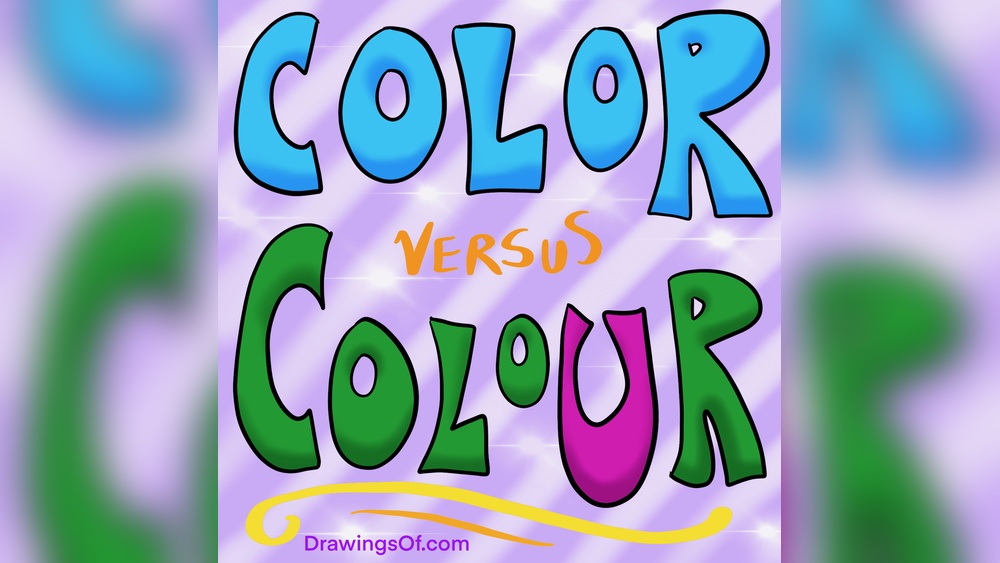
Are you ever unsure whether to spell it “color” or “colour”? You’re not alone.
This tiny difference can cause big confusion, especially if you write for an audience around the world. But here’s the secret: knowing when and why to use each spelling can make your writing clearer and more professional. You’ll discover exactly how to spell “color” correctly depending on where you are or who you’re writing for.
Ready to master this simple yet important detail? Let’s dive in and clear up the mystery once and for all.
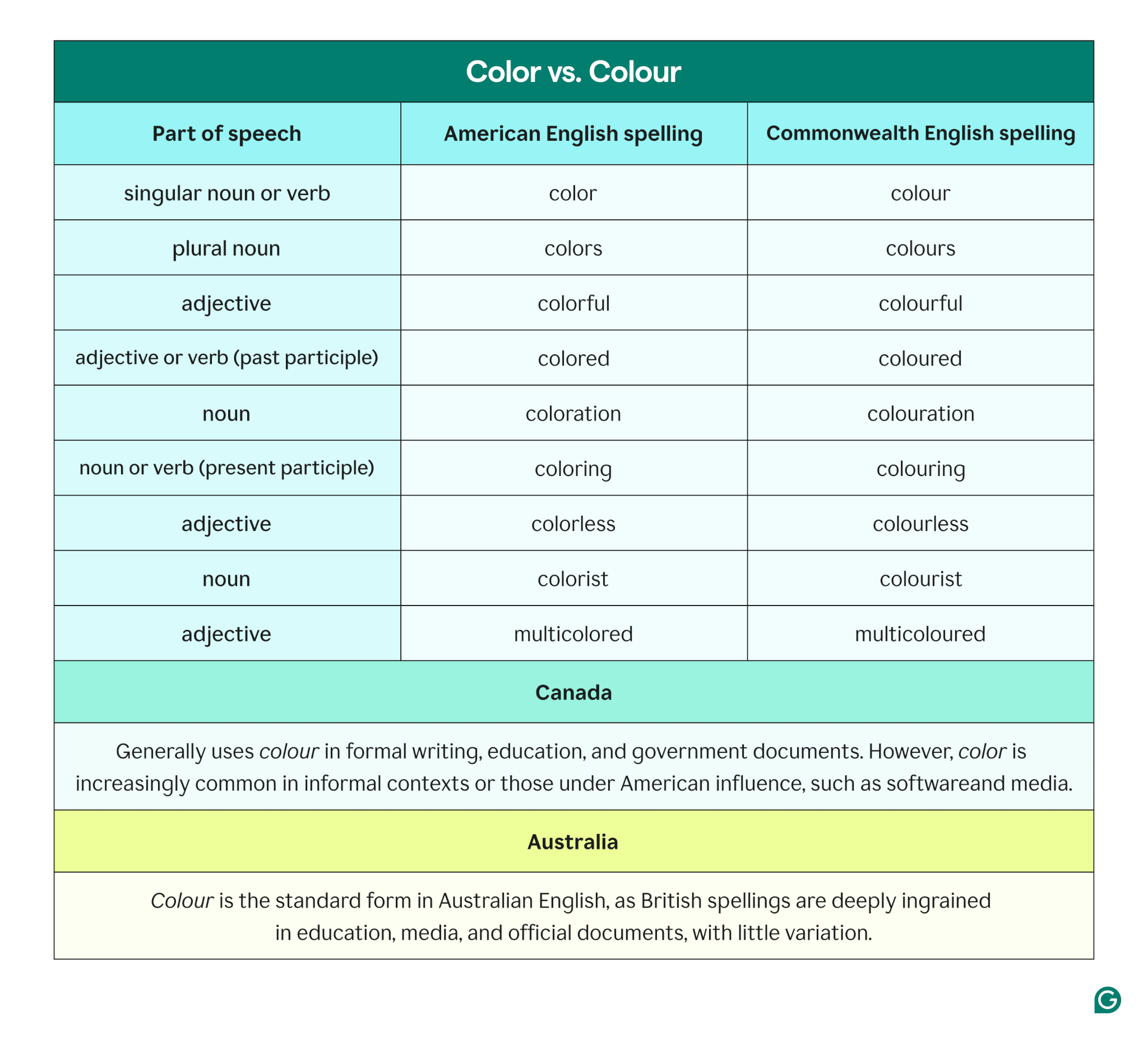
Credit: www.grammarly.com
American Vs British Spelling
Spelling differences between American and British English can confuse many learners. One common example is the word for the visual perception we see in objects. Americans write it as “color,” while the British write it as “colour.”
This difference is not random. It reflects a broader pattern in English spelling, influenced by history and culture. Understanding these patterns helps in reading, writing, and communicating effectively.
American Spelling: Color
In American English, the word is spelled “color” without the letter “u.” This form is simpler and shorter. It follows a trend started in the early 1800s by Noah Webster. Webster wanted to create a distinct American style of English. He removed letters he thought were unnecessary. As a result, words ending in “-our” in British English often end in “-or” in American English.
Examples include “honor,” “favorite,” and “labor.” This spelling is now standard in the United States and used in official documents, schools, and media.
British Spelling: Colour
British English keeps the spelling “colour” with the letter “u.” This spelling comes from older English and French influences. It preserves the traditional form used for centuries. Many countries that follow British English also use “colour,” such as the United Kingdom, Australia, and India.
This form feels more formal and classic to many readers. It also matches other words like “favour,” “honour,” and “labour,” which keep the “u.”
Impact On Other Related Words
The difference in spelling also applies to related words. For example, Americans write “coloring” and “colorful.” British English uses “colouring” and “colourful.” This pattern is consistent across many words. It helps keep the system logical and predictable for learners and speakers.
Knowing these variations can improve understanding and avoid mistakes in writing. It also shows respect for the language customs of different regions.
Credit: www.kindergartenworks.com
Origins Of The Color Spelling
The spelling of the word “color” has a rich history tied to language evolution. It reflects different traditions in English-speaking countries.
The main difference is between “color” and “colour.” This split shows how English adapted in various regions.
British English Influence
British English uses the spelling “colour” with a “u.” This form comes from Old French and Latin roots.
The “u” was kept as English spelling followed French patterns. This style is common in the UK and many Commonwealth countries.
American English Simplification
American English spells the word as “color,” dropping the “u.” This change started in the early 1800s.
Noah Webster, a key American lexicographer, pushed for simpler spellings. His goal was to make American English easier to learn and distinct.
Global Variations And Usage
Other English-speaking countries follow either British or American spelling. Canada often uses “colour,” but “color” appears too.
Understanding these origins helps with correct spelling in writing and communication worldwide.
Noah Webster’s Influence
Noah Webster played a key role in shaping American English spelling. His work in the early 1800s aimed to simplify and standardize spellings. This helped distinguish American English from British English.
Webster believed simpler spellings made words easier to read and write. He removed silent letters and shortened words. One famous example is the word “color,” which he spelled without the “u.”
Noah Webster’s Spelling Reforms
Webster introduced many spelling changes in his dictionaries. He preferred “color” over the British “colour.” This change reduced unnecessary letters. It made writing faster and more straightforward.
The Impact On American English
Webster’s dictionary became very popular in the United States. His spellings were taught in schools and used by writers. Over time, American English adopted these simpler forms as standard.
Why “color” Lost The “u”
Webster removed the “u” in “colour” to reflect how Americans spoke. He wanted a clear, distinct American identity in language. This spelling stuck and remains common in the US today.
Color Spelling In The United States
In the United States, the word for hues and shades is spelled as color. This spelling differs from the British English version, which includes a “u” and is spelled colour. The American spelling is shorter and simpler.
This difference comes from efforts to simplify English spelling in the U.S. Noah Webster, a famous lexicographer, pushed for these changes in the 19th century. His goal was to make American English easier to learn and use.
Because of Webster’s influence, many words that end with “-our” in British English drop the “u” in American English. Words like honour and favour follow the same pattern as colour, becoming honor and favor.
American English Simplification
American English often favors shorter spellings. This makes writing and reading quicker. The word color is a prime example. It shows how U.S. English reduces extra letters for clarity.
Common Usage In The United States
In schools, books, and official documents in the U.S., color is the standard spelling. This applies to all forms of the word, like colorful, coloring, and colorize. Using the British spelling may seem unusual or incorrect to many Americans.
Impact On Technology And Media
Software, websites, and media produced in the U.S. follow the American spelling. For example, user interfaces often say “color settings,” not “colour settings.” This consistency helps users understand and trust the content.
Colour Spelling In The United Kingdom
In the United Kingdom, the spelling of the word for hues and shades includes a distinctive letter. Unlike American English, British English retains the letter “u” in the word. This tradition affects not only the word “colour” but also related words such as “colouring” and “colourful.” The choice to keep the “u” follows the historical roots of English spelling and reflects the influence of French on the language.
Understanding this spelling difference helps when reading or writing in UK English. It also explains why you might see different versions of the same word depending on the region. The UK spelling is standard in schools, official documents, and media across Britain and other countries that follow British English.
Historical Origins Of “colour” In Uk English
The spelling “colour” dates back to Middle English, influenced by Old French. The “u” was part of the word as English adopted many French words after the Norman conquest. This form was preserved in British English, keeping the link to its linguistic history.
Common Usage In British Writing And Media
British newspapers, books, and websites use “colour” consistently. This spelling appears in official communications and educational materials. It signals adherence to UK English standards and helps maintain uniformity in the language.
Differences Between Uk And Us English Spelling
American English simplifies the word to “color,” dropping the “u.” This change was part of spelling reforms in the 19th century. British English, however, kept the original spelling. This difference is common in other words ending with “-our” in the UK, such as “favour” and “honour.”
Canadian Spelling Variations
Canadian spelling blends American and British English styles. It often follows British spelling rules but also adopts American forms in some cases. This mix reflects Canada’s unique cultural and historical influences.
In the case of the word “color,” Canadians use the British spelling “colour.” The extra “u” remains in most Canadian writing, distinguishing it from the American “color.”
Other words with similar endings, such as “favour,” “honour,” and “labour,” also keep the British “u” in Canadian English. This pattern shows a clear preference for British conventions.
Despite this, Canadian English sometimes leans toward American spelling. Words like “tire” (instead of “tyre”) and “organize” (instead of “organise”) follow American rules. This mixture makes Canadian English unique.
Why Canada Uses “colour” Instead Of “color”
Canada’s history with Britain influences its spelling choices. Early settlers brought British English spelling. Schools and government documents have kept British forms standard.
Common Canadian Spelling Patterns
Canadian English often keeps the British “ou” in words like “colour” and “neighbour.” It also uses British endings like “-re” in “centre” and “-ce” in “defence.”
When Canadian English Favors American Spelling
Some technical or modern terms adopt American spelling. Examples include “tire,” “program,” and “organize.” Media and technology sectors often prefer American forms.
Australian English And Colour
Australian English closely follows British English spelling conventions. This includes many words ending in “-our,” such as “colour.”
Unlike American English, Australian English retains the “u” in colour. This choice reflects historical ties to the United Kingdom.
Understanding these differences helps with writing correctly for Australian audiences.
Why Australian English Uses “colour”
Australia’s language roots come from British colonization. Spelling rules stayed true to British forms. “Colour” is one example of this tradition.
Australian style guides and dictionaries support using “colour” with a “u” as standard.
Common Australian English Words With “-our”
Many words use the “-our” ending in Australian English. Examples include:
- Colour
- Honour
- Flavour
- Favour
These words differ from American English, which often drops the “u.”
Spelling Tips For Australian English Writers
Check your spelling tools to set Australian English as default. This helps avoid mistakes. Be aware that Australian English prefers “colour” instead of “color.”
Review style guides for Australian writing to ensure proper usage.
Common Words With -or Vs -our Endings
Words ending with -or and -our often confuse English learners. The difference mainly depends on the version of English you follow. American English tends to use -or, while British English prefers -our. This variation affects many common words beyond just “color” and “colour.”
Understanding these spelling differences helps in writing clearly. It also ensures your text matches your audience’s expectations. Below are some frequent examples of words with -or and -our endings.
-or in American EnglishAmerican English uses -or endings for words like “color,” “honor,” and “favor.” These spellings are shorter and simpler. They were popularized by Noah Webster in the 19th century. Webster aimed to create a distinct American English style. This spelling style is standard in the United States and often in Canada.
-our in British EnglishBritish English spells these words with -our, such as “colour,” “honour,” and “favour.” This form reflects older English usage. It is common in the United Kingdom, Australia, and other Commonwealth countries. The -our endings often appear in formal and traditional texts.
Common Words With Both Spellings
Many words have two accepted spellings. Examples include “color/colour,” “flavor/flavour,” and “labor/labour.” Choose the spelling that fits your audience’s region. Consistency is key. Avoid mixing both forms in one document.
Tips To Remember The Difference
Remembering the difference between “color” and “colour” can be simple with a few easy tips. These tips help you know when to use each spelling. Knowing this improves your writing and makes your text clear to readers.
Focus on the origin of the word and the country you are writing for. This helps you choose the right spelling every time. Here are some practical tips to keep the difference in mind.
Know The Regional Preference
American English uses “color” without the letter “u”. British English and many Commonwealth countries use “colour” with the “u”.
Think about your audience. Write “color” for American readers. Use “colour” for British or Canadian readers. This small step avoids confusion.
Remember Noah Webster’s Spelling Reform
Noah Webster simplified American English spelling in the 1800s. He removed the “u” from words like “colour”.
Keep this fact in mind. It explains why Americans spell “color” differently. It helps you remember which spelling fits American English.
Use Mnemonics To Help You Recall
Try this: “Color” is “co” + “lor” like “coast” without extra letters.
For “colour”, remember the “u” stands for “United Kingdom” and its spelling style. This trick helps you choose the right form quickly.
Check Your Writing Context
Look at other words around “color” or “colour”. If you see “favour” or “honour”, use “colour”.
If the text uses “favor” and “honor”, use “color”. Matching spellings keeps your work consistent.
Practice With Examples
Write sentences using both spellings. For example, “The color of the sky is blue” for American English.
Or, “The colour of the sky is blue” for British English. Practice helps your brain remember the difference.
Impact On Writing And Communication
The way you spell “color” can shape how your writing is seen. Using the correct form affects clarity and reader connection. It also shows respect for your audience’s language background.
Spelling impacts the tone and professionalism of your text. Choosing between “color” and “colour” signals your regional style. This choice helps readers feel more comfortable and engaged.
Consistency In Spelling
Keeping one spelling style throughout your writing avoids confusion. Mixing “color” and “colour” looks careless and distracts readers. Consistent spelling builds trust and improves readability.
Audience Expectations
Know your readers’ location to match their spelling preference. American readers expect “color,” while British readers look for “colour.” Meeting these expectations makes your message clearer.
Professional Communication
Correct spelling reflects attention to detail in business writing. Using the right form enhances your credibility. It shows you understand cultural differences in English.
Impact On Digital Content
Search engines recognize regional spelling differences. Using the right term improves your blog’s SEO. It helps attract the right audience to your content.
Credit: www.youtube.com
Frequently Asked Questions
Which Spelling Is Correct, Color Or Color?
“Color” is correct in American English, while “colour” is correct in British English. Both spellings are valid regionally.
How Do Americans Spell Color?
Americans spell it “color,” without a “u. ” This American English spelling differs from British English “colour. “
How Is Color Spelled In Canada?
In Canada, color is spelled “colour,” following British English. Canadian spelling blends British and American styles uniquely.
Is It Color Or Colour In Australia?
In Australia, the correct spelling is “colour” with a “u. ” Australian English follows British spelling conventions.
What Is The Correct Spelling Of Color In American English?
In American English, the word is spelled “color” without the letter “u. “
Why Do Some Countries Spell Color As “colour”?
Countries using British English, like the UK, spell it as “colour” with a “u. “
Who Influenced The American Spelling Of Color?
Noah Webster influenced American spelling, removing the “u” to simplify words like color.
How Do Canadians Spell The Word Color?
Canadians use both “color” and “colour,” but “colour” is more common in Canada.
Is “color” Or “colour” Used In Australian English?
Australian English follows British rules and typically uses “colour” with a “u. “
Does The Spelling Change Affect The Meaning Of Color?
No, both “color” and “colour” mean the same thing; only spelling differs.
Conclusion
Understanding the difference between “color” and “colour” helps with clear communication. American English uses “color” without the “u. ” British and Canadian English prefer “colour” with the “u. ” Both spellings are correct depending on where you are. Choose the one that fits your audience or style.
This small detail makes your writing look polished and professional. Remember, spelling reflects culture and history. Keep practicing, and spelling will become easier over time.